Fake Reviews vs Real Reviews in 2026: 10 Warning Signs Before You Buy Anything Online
Review2Rate team,
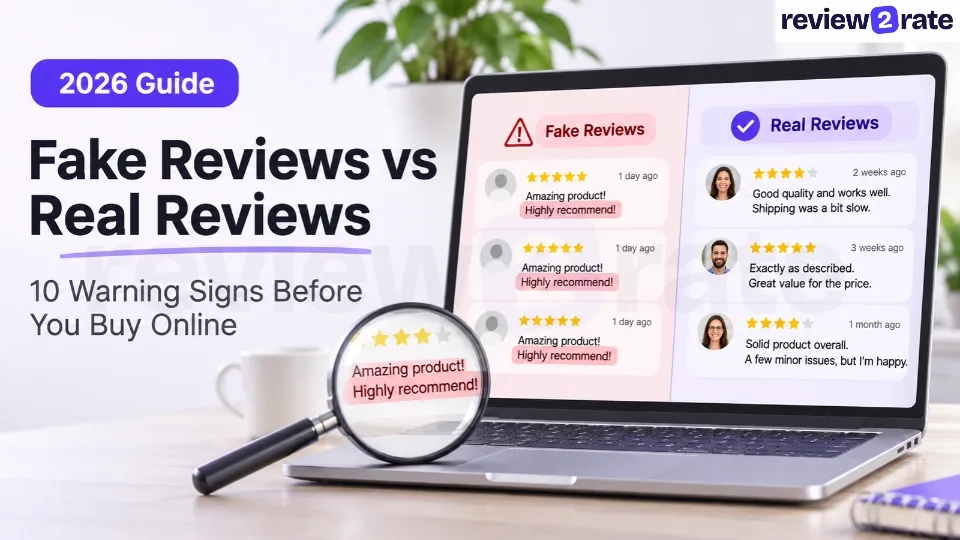
Fake Reviews vs Real Reviews in 2026: 10 Warning Signs Before You Buy Anything Online
Imagine ordering a smartphone, booking a hotel, visiting a restaurant or buying a household appliance because it has thousands of five-star reviews. Everything looks perfect until you actually use the product or service. Suddenly, the experience is completely different from what the ratings promised.
That is why understanding the difference between fake reviews and real reviews has become an essential skill for online shoppers in 2026.
Customer reviews influence purchasing decisions across almost every category, from electronics and fashion to restaurants, hotels, educational services, home repairs and local businesses. Reviews are valuable because they can reveal what marketing materials often leave out: everyday reliability, customer support, hidden costs and problems that appear after purchase.
Unfortunately, not every review represents an authentic customer experience. Some ratings may be purchased, coordinated, posted by people who have never used the product or generated with artificial intelligence.
However, identifying fake reviews is not always straightforward. A short five-star review is not automatically fake, and a detailed negative review is not automatically genuine.
In this guide, we explain 10 warning signs of potentially fake reviews, how to evaluate suspicious ratings, what Indian consumer-protection standards say and how to make better decisions before spending your money.
What Are Fake Reviews?
A fake review is a rating or testimonial that misrepresents a person's real experience with a product, service or business.
Fake or misleading reviews can take several forms. Some are entirely fabricated, while others may be written by real people who have been offered rewards in exchange for a particular rating or opinion.
Examples include:
- Five-star ratings submitted by people who never purchased or used the product.
- Negative reviews deliberately posted to damage a competing business.
- Reviews written by employees or business owners without disclosing their relationship.
- Paid recommendations presented as independent customer experiences.
- AI-generated testimonials describing experiences that never happened.
- Reviews copied between unrelated products, services or business listings.
- Coordinated campaigns designed to artificially improve or damage public ratings.
The important distinction is honesty about actual experience. A genuine review may be positive, negative or mixed. A deceptive review misleads readers about who wrote it, what they experienced or why they posted it.
Why Fake Reviews Are a Serious Problem in 2026
Online ratings are often one of the first things customers examine before making a purchase.
A product with a 4.8-star rating may appear more trustworthy than a competing product with 4.2 stars, even when the second product is better suited to the customer's needs.
For businesses, positive reviews can help attract new customers. Negative reviews can influence where people shop, eat, stay or seek services.
This creates an incentive for dishonest participants to manipulate review systems.
Artificial intelligence has also made it easier to generate large amounts of convincing text. A fabricated review no longer needs to consist of a few awkward sentences. It can be detailed, grammatically correct and written in a seemingly natural style.
That does not mean every polished review is suspicious. It means shoppers should evaluate the evidence and context surrounding a review instead of relying on writing style alone.
1. Too Many Five-Star Reviews Appearing at Once
Warning sign: A product or business suddenly receives an unusually large number of highly positive reviews within a very short period.
Imagine a local restaurant receiving only a handful of reviews each month and then gaining 200 five-star ratings over a weekend.
That sudden increase deserves a closer look, particularly if the comments are vague or repetitive.
Similar patterns can appear on product listings that receive a large number of positive ratings before there has been reasonable time for customers to test the item.
However, review spikes are not definitive proof of manipulation. A genuine product launch, viral video, successful promotion or large customer event can also produce increased review activity.
What to check: Compare the dates, review content and product launch timeline. Look for consistent experiences across different periods rather than judging a listing solely by a sudden increase in ratings.
2. Multiple Reviews Use Almost Identical Language
Warning sign: Different reviewers repeatedly use the same unusual phrases, sentence structures or promotional wording.
For example:
- "Amazing quality, best product, highly recommended to everyone."
- "Amazing quality and best product. Highly recommended to all."
- "Best quality product, amazing experience, highly recommended."
These examples are not automatically fraudulent. Some genuine reviewers write similar short comments.
The concern becomes stronger when many reviews repeat an unusual phrase, mention the same marketing claims or appear within a suspiciously narrow timeframe.
Coordinated review campaigns may provide reviewers with suggested wording. Automated systems may also generate multiple variations of the same message.
What to check: Look for personal details that distinguish one experience from another, such as delivery circumstances, usage duration, service interactions or specific product limitations.
3. Reviews Praise Everything but Explain Nothing
Warning sign: A large share of reviews consists of enthusiastic claims with little information about actual use.
Statements such as "Perfect product," "Excellent service" or "Best purchase ever" may be genuine, but they tell readers very little.
A more informative smartphone review might discuss battery life, camera performance, software experience and charging behaviour.
A useful restaurant review might mention the food ordered, waiting time, hygiene, staff behaviour and overall value.
For a hotel, relevant information could include cleanliness, noise, check-in experience and the accuracy of listing photographs.
What to check: Prioritise reviews describing observable experiences. Avoid assuming that vague reviews are fake, especially when customers are simply leaving quick feedback.
4. The Reviewer Mentions the Wrong Product or Business
Warning sign: A review contains details that do not match the item or business being rated.
For example, a review for wireless earbuds might discuss a smartphone's camera quality.
A review of a restaurant may unexpectedly describe hotel rooms.
These mismatches can suggest copied reviews, misplaced feedback or dishonest review activity.
However, some shopping platforms combine reviews across multiple product variants, and listings may change over time.
What to check: Verify the review's product variation, purchase date and listing details. A mismatch is a reason to investigate rather than immediate proof of a fake review.
5. Reviewers Have Suspicious or Unusual Activity Patterns
Warning sign: A review account appears to post repetitive ratings across unrelated products or businesses in an implausibly short period.
For example, an account might review several businesses in distant cities on the same day while claiming detailed personal experiences at each location.
Another profile may repeatedly award identical ratings with promotional language across unrelated categories.
Some platforms allow users to view a reviewer's public contribution history. When available, this can provide useful context.
Be careful not to judge people simply because they are new reviewers, travel frequently or prefer short comments.
What to check: Look for consistency and plausible experience, not arbitrary assumptions about how many reviews a legitimate customer should write.
6. The Reviews Sound Like Advertisements
Warning sign: A customer review reads more like a promotional script than a description of personal experience.
Examples include repeated references to discount codes, sales slogans, calls to purchase immediately or descriptions copied from a manufacturer's product page.
Businesses are allowed to advertise, and sponsored content can provide useful information when the commercial relationship is clearly disclosed.
The problem arises when promotion is presented as an independent customer opinion.
For example, a paid endorsement that appears to be an ordinary customer review can mislead readers if the relevant relationship is concealed.
What to check: Look for sponsorship notices, affiliate disclosures and statements about free products or other incentives. Treat undisclosed commercial influence as a trust concern.
7. Reviews Appear Before Realistic Product Usage Is Possible
Warning sign: A newly launched product receives detailed claims about long-term durability before customers could reasonably have tested it.
Imagine a washing machine launching this week and immediately receiving numerous reviews claiming that it has performed flawlessly for two years.
Such a timeline would be inconsistent unless the reviewer had legitimate access to an earlier version, a long-term test unit or a different product variant.
Similarly, detailed battery-health claims for a newly released smartphone deserve scrutiny if they supposedly reflect years of ownership.
What to check: Compare launch dates with the review's claimed usage period. Look for clearly disclosed early-access testing or other reasonable explanations.
8. Every Negative Review Is Dismissed or Missing
Warning sign: A business displays overwhelmingly positive testimonials but offers little transparency about how reviews are collected or moderated.
No product or service will satisfy every customer in every situation.
Even highly regarded businesses may receive complaints about delivery, scheduling, price, availability or customer service.
That does not mean every business must have negative reviews. A small or new business may simply have received limited feedback.
But consumers should become cautious when a site claims to publish independent customer experiences while showing only selected praise, without explaining its review policy.
Review suppression can also distort customer expectations if negative feedback is hidden because of its rating rather than because it violates a legitimate moderation rule.
What to check: Read the platform's moderation policy, compare reviews across independent sources and examine how businesses respond to constructive criticism.
9. AI-Generated Reviews Make Unrealistic Claims
Warning sign: A review contains polished but inconsistent details, invented features or experiences that do not match the product.
AI tools can generate believable reviews about almost any product or service. They may imitate a customer describing a hotel stay, smartphone purchase or restaurant visit.
However, AI-generated text is not necessarily dishonest. A genuine customer might use an AI writing tool to improve grammar while accurately describing a real experience.
The issue is whether the review truthfully represents actual use or experience.
Likewise, automated AI-text detectors cannot reliably establish whether a review is fraudulent.
What to check: Look for verifiable product details, realistic timelines, consistency with official specifications and corroborating experiences from other customers.
10. Ratings Look Excellent but Independent Experiences Tell a Different Story
Warning sign: A product or business receives near-perfect scores on one platform while detailed customer experiences elsewhere repeatedly describe serious problems.
For example, an online seller may display hundreds of positive reviews while independent customers consistently report difficulties obtaining refunds.
A service provider might promote excellent testimonials while unrelated discussion forums describe repeated appointment cancellations.
Differences between platforms are not automatically evidence of fraud. Review audiences, expectations and moderation practices vary.
However, substantial contradictions deserve further investigation before making an expensive or difficult-to-reverse purchase.
What to check: Compare information from several credible sources. Focus on recurring, specific issues rather than isolated complaints or unsupported allegations.
Fake Reviews vs Real Reviews: Key Differences
| Factor | More Trustworthy Review Signals | Potential Warning Signs |
|---|---|---|
| Personal Experience | Specific, plausible details | Claims inconsistent with actual use |
| Writing Style | Natural variation among reviewers | Unusual repeated promotional language |
| Review Timing | Activity consistent with sales and usage | Unexplained coordinated rating spikes |
| Product Details | Correct model and relevant features | Wrong products or impossible claims |
| Positive and Negative Points | Useful observations about strengths or weaknesses | One-sided promotional patterns without context |
| Reviewer History | Plausible contribution patterns | Repeated suspicious behaviour across unrelated listings |
| Images and Videos | Relevant media consistent with the experience | Unrelated, copied or misleading imagery |
| Commercial Relationships | Relevant incentives and affiliations disclosed | Undisclosed paid or insider promotion |
| Platform Transparency | Clear review collection and moderation policies | Unexplained suppression or selective presentation |
| Cross-Platform Evidence | Broadly consistent independent experiences | Major unexplained contradictions |
Important: None of these signals proves that an individual review is fake. They are practical indicators that should be considered together.
Can You Trust a Five-Star Rating in 2026?
A five-star rating can be helpful, but it should never be treated as a guarantee of quality.
Ratings often summarise different types of experiences into a single number.
One customer might rate a smartphone highly because of its camera. Another may give the same phone a poor score because of battery life.
Both reviews could be genuine.
Similarly, a restaurant may have excellent food but inconsistent delivery service. A hotel may offer good rooms while suffering from unreliable internet connectivity.
Instead of relying exclusively on the average score, examine the review distribution and read several detailed reviews.
A product with a slightly lower average rating but consistent, informative feedback may be more useful to evaluate than a product with a nearly perfect rating and little explanation.
Why Three-Star and Four-Star Reviews Can Be Especially Useful
Moderately positive reviews often describe both advantages and limitations.
For example, a four-star laptop review might explain that the device performs well for office work but has limited ports.
A three-star hotel review might praise the location while noting problems with cleanliness or noise.
This combination can help buyers decide whether a product's limitations matter to them.
However, star level alone does not determine authenticity. Both moderate and extreme ratings can be genuine or manipulated.
The best approach is to read across multiple rating levels and look for specific information relevant to your priorities.
Are Verified Purchase Reviews Always Genuine?
No. A verified purchase label provides useful context, but it is not a complete guarantee of review authenticity.
Such labels generally indicate that a platform has connected a review to an eligible transaction according to its own rules.
However, a person may purchase a product and still provide dishonest or incentivised feedback.
Some review-manipulation schemes may involve real transactions, reimbursements or rewards.
At the same time, an unverified review is not automatically fake. Someone may have purchased the product elsewhere or received a service through another channel.
Use purchase verification as one credibility factor alongside review quality, timing, relevance and disclosure.
How to Spot Fake Reviews on Amazon and Other Shopping Websites
When shopping for electronics, appliances, clothing or household products, use the following checks:
- Read recent customer reviews as well as the highest-rated reviews.
- Confirm that the review refers to the exact product model or variation.
- Look for specific comments about build quality, durability and actual use.
- Compare recurring complaints with independent product testing.
- Check whether the listing combines reviews for multiple variants.
- Review product images shared by customers, while remembering that images can also be reused or manipulated.
- Check return eligibility, warranty coverage and seller information separately from star ratings.
- Be cautious when reviewers mention refunds, rewards or gifts tied to particular feedback.
For expensive products, compare both the product's reviews and the seller's reliability. A well-reviewed product sold by an unreliable seller can still result in a poor purchasing experience.
How to Identify Suspicious Google Reviews for Local Businesses
Google reviews can help people compare restaurants, hotels, salons, repair centres, clinics, shops and other local services.
However, a business's overall rating may not answer every practical question.
Before visiting a business, consider:
- Whether recent reviews describe the same service you need.
- Whether reviewers mention specific visits, purchases or appointments.
- Whether recurring complaints concern issues important to you.
- Whether business responses are professional and address the substance of complaints.
- Whether review dates and activity patterns appear plausible.
- Whether operating hours, contact details and service information agree with other reliable sources.
For example, a repair shop might have excellent customer-service reviews but limited feedback about long-term repair quality.
A restaurant might have high dine-in ratings while delivery customers report a different experience.
Read reviews for the specific service, location and time period relevant to your decision.
Fake Negative Reviews and Review Bombing
Not all review manipulation is designed to increase ratings.
Some campaigns attempt to damage a product or business through coordinated negative reviews.
This is sometimes described as review bombing when a large group posts low ratings, potentially for reasons unrelated to genuine customer experience.
A sudden wave of negative ratings may reflect organised manipulation, but it can also follow a genuine service failure, product defect or controversial business decision.
Therefore, unusual activity should prompt investigation rather than an automatic conclusion.
Businesses should respond to substantive criticism and use legitimate reporting or appeals processes for suspected fraudulent reviews.
Threatening customers or suppressing legitimate negative feedback can further damage trust.
What Does Indian Law Say About Fake Online Reviews?
India has taken steps to address deceptive practices and improve transparency in online consumer reviews.
In November 2022, the Bureau of Indian Standards introduced IS 19000:2022, Online Consumer Reviews — Principles and Requirements for their Collection, Moderation and Publication.
The standard addresses the way online reviews are collected, managed and published, including principles related to integrity, transparency, accuracy and protection of consumer interests.
The government initially described compliance with the standard as voluntary. Consumers should not assume that every platform is certified or follows the same verification procedures.
In February 2026, BIS also published a certification scheme concerning processes for collecting, moderating and publishing online consumer reviews.
These developments recognise the importance of trustworthy review systems for consumers and businesses alike.
India's E-Commerce Rule Changes: What Happens in 2027?
The Indian government notified the Consumer Protection (E-Commerce) (Amendment) Rules, 2026 in September 2026.
These amendments are scheduled to take effect on 1 January 2027.
Among other changes, the rules strengthen requirements concerning sponsored-listing disclosures, misleading search-result manipulation, price-reduction information, consumer complaints and seller-related transparency.
These changes are relevant to the broader issue of online trust, but they should not be confused with a dedicated new rule declaring every suspicious review illegal.
Online shoppers should distinguish between review-authenticity standards, consumer-protection obligations and separate requirements for e-commerce advertising or disclosures.
For current requirements and reporting procedures, consult official government guidance rather than relying on social-media summaries.
How Artificial Intelligence Is Changing Fake Reviews
Artificial intelligence has created both opportunities and challenges for online review platforms.
AI can assist with language analysis, suspicious-pattern detection and moderation workflows.
At the same time, generative AI can produce convincing descriptions of experiences that never occurred.
For example, a fabricated hotel review may include plausible descriptions of the room, staff and breakfast service without any actual visit.
AI can also generate multiple variations of similar text, making simple duplicate-wording checks less effective.
Nevertheless, AI-generated writing is not automatically fraudulent. The central question remains whether the reviewer genuinely experienced what they describe.
Reliable review systems should evaluate several signals together instead of automatically rejecting polished or AI-assisted writing.
Can AI Tools Reliably Detect Fake Reviews?
No automated tool can guarantee that every review it flags is fraudulent.
AI-based detection systems may identify unusual patterns or suspicious content, but they can make mistakes.
A legitimate reviewer who writes briefly or uses AI for grammar correction could be incorrectly flagged.
A fabricated review written carefully by a human could escape automated detection.
For consumers, automated scores should be treated as additional information rather than final proof.
For review platforms, a balanced approach may include transparent policies, reasonable verification, abuse reporting and human review of disputed cases.
How to Check Whether an Online Review Is Trustworthy
Before buying an expensive product or booking an important service, follow this practical verification process.
- Identify your priorities: Decide which characteristics matter most, such as durability, service quality or value.
- Read multiple rating levels: Include positive, mixed and negative feedback.
- Check the timeline: Compare review dates with the product's availability and claimed usage.
- Look for specific experiences: Prioritise relevant details over enthusiastic slogans.
- Verify the exact item: Make sure reviews match the model, variant or business location.
- Consider incentives: Look for relevant commercial disclosures.
- Compare independent sources: Search beyond the seller's own website.
- Check factual claims: Compare specifications, warranties and policies with official information.
- Evaluate recurring issues: Look for repeated concerns from different customers.
- Make your own decision: Consider the total evidence rather than a single star rating.
This method does not guarantee a perfect purchase, but it can reduce reliance on potentially misleading feedback.
A Practical Example: Buying a Smartphone Online
Suppose you are comparing two smartphones.
Phone A has an average customer rating of 4.9 stars, but many reviews simply say "Excellent phone" or "Best mobile."
Phone B has an average rating of 4.4 stars, with detailed comments about battery performance, charging, camera quality and software updates.
Should you automatically choose Phone B?
Not necessarily. Average ratings can be influenced by many factors, and detailed reviews can also be misleading.
However, Phone B's informative feedback may make it easier to judge whether the device meets your particular needs.
The better decision is to compare specifications, independent testing, recent reviews and seller reliability before purchasing either device.
A Practical Example: Choosing a Restaurant or Local Business
Imagine choosing between two restaurants.
Restaurant A has hundreds of five-star ratings, but most comments provide almost no details.
Restaurant B has a slightly lower average rating, with customer experiences discussing food quality, cleanliness, prices and waiting times.
If your main priority is a quiet family dinner, reviews mentioning seating, noise and service may be more useful than generic praise.
The same principle applies to salons, hotels, repair shops and other services.
Trustworthy decision-making is about finding relevant evidence, not simply choosing the highest number.
How to Write a Genuine and Helpful Review
Authentic reviews are valuable because they help other people make informed decisions.
You do not need professional writing skills or elaborate explanations to contribute useful feedback.
A good review should focus on what actually happened.
- Describe your experience: Explain what you purchased, used or visited.
- Include relevant details: Mention performance, quality, price or service where applicable.
- Be balanced: Discuss both strengths and weaknesses when relevant.
- Avoid unsupported accusations: Describe observable facts rather than making claims you cannot substantiate.
- Disclose important relationships: Be transparent about relevant incentives or affiliations.
- Respect privacy: Do not publish private personal information.
- Update your review when appropriate: A later repair, replacement or customer-service resolution may change your experience.
A short but specific review can be more helpful than a long promotional paragraph.
Why Community-Driven Reviews Matter
Independent customer experiences help people understand products and businesses from perspectives that advertisements cannot provide.
Someone researching a refrigerator may want to know how well it performs after months of use.
A family choosing a hotel may be interested in cleanliness and accessibility.
A customer looking for a local service provider may value punctuality, communication and transparent pricing.
Community-driven review platforms create opportunities for these different experiences to become part of a broader conversation.
However, no review website should assume that community participation alone guarantees authenticity. Clear rules, fair moderation and transparent handling of suspicious activity remain important.
At Review2Rate, the idea is simple: people can share their opinions and experiences about products, businesses, services and more, helping others research their choices.
When contributing, the most valuable approach is to share what you genuinely experienced rather than what a business or advertiser wants readers to hear.
Real Reviews. Real Experiences. For the People, By the People.
What Should You Do If You Find a Suspicious Review?
If you notice a review that appears deceptive, consider the following steps:
- Use the platform's reporting option, if available.
- Explain the specific reason for your concern rather than simply saying the rating looks fake.
- Avoid publicly accusing individual reviewers without reliable evidence.
- Keep relevant screenshots or records if the issue affects a transaction or consumer complaint.
- Contact the seller or platform through official support channels when appropriate.
- For unresolved consumer grievances in India, consider the National Consumer Helpline and applicable complaint mechanisms.
A suspected fake review is not the same as a proven violation. Fair processes should allow concerns to be assessed without targeting legitimate customer opinions.
10-Point Checklist Before Trusting Online Reviews
| Check | Question to Ask |
|---|---|
| 1. Timing | Did the reviews appear in a plausible period? |
| 2. Specificity | Do reviewers describe useful experiences? |
| 3. Repetition | Are unusual phrases repeated across many reviews? |
| 4. Product Match | Does the feedback refer to the correct item or service? |
| 5. Reviewer Context | Does the visible activity provide reasonable context? |
| 6. Incentives | Are sponsorships or rewards disclosed? |
| 7. Usage Claims | Are long-term claims consistent with the timeline? |
| 8. Moderation | Is the review policy reasonably transparent? |
| 9. Cross-Checking | Do independent sources support major claims? |
| 10. Relevance | Does the feedback answer your actual buying questions? |
Frequently Asked Questions About Fake and Real Reviews
1. How can I identify fake reviews online?
Check for unusual rating spikes, repetitive promotional wording, impossible usage claims, mismatched product details and undisclosed incentives. Use several signals together because no single warning sign proves fraud.
2. Are all five-star reviews fake?
No. Many customers genuinely have excellent experiences. A five-star rating becomes more useful when supported by specific, plausible feedback.
3. Can negative reviews also be fake?
Yes. Deliberately fabricated negative reviews may be used to harm competitors or influence ratings. Legitimate criticism should not be dismissed merely because it is negative.
4. Are verified purchase reviews completely reliable?
No. Purchase verification provides additional context, but it does not guarantee that the review is honest, unbiased or free from incentives.
5. Can artificial intelligence create fake customer reviews?
Yes. Generative AI can produce convincing fictional testimonials. However, AI-assisted writing is not necessarily deceptive when it accurately reflects a real person's experience.
6. Can AI detectors identify every fake review?
No. Automated tools can generate false positives and miss deceptive content. Their findings should be evaluated alongside other evidence.
7. Why do some businesses have only positive reviews?
There may be legitimate reasons, such as limited review volume or strong customer satisfaction. However, consumers should investigate whether the business selectively publishes feedback or provides unclear moderation policies.
8. What is review bombing?
Review bombing generally refers to coordinated waves of negative ratings intended to influence a public score. A sudden increase in complaints can also reflect genuine problems, so the cause must be assessed carefully.
9. Can a business pay people to write reviews?
Rules depend on the jurisdiction and circumstances. Incentivised feedback may raise legal and ethical concerns, especially when the reward is tied to a particular rating or the commercial relationship is concealed.
10. Does India have standards for online consumer reviews?
Yes. BIS published IS 19000:2022 concerning the collection, moderation and publication of online consumer reviews. The government initially described the standard as voluntary.
11. What changes are coming to Indian e-commerce rules in 2027?
The Consumer Protection (E-Commerce) (Amendment) Rules, 2026 are scheduled to take effect on 1 January 2027. They address matters including sponsored listings, search-result transparency, price disclosures and consumer grievance processes.
12. Are reviews with photos always genuine?
No. Photos can support a review, but images may be copied, reused, edited or taken from unrelated sources. Check whether the images match the experience being described.
13. Should I trust a product with thousands of reviews?
Review quantity can provide useful context, but it does not establish authenticity. Consider recency, relevance, review distribution and independent evidence.
14. Why are detailed reviews usually more helpful?
Specific descriptions help buyers understand how a product or service performs in circumstances similar to their own. Detail improves usefulness but does not independently prove authenticity.
15. How can I write a trustworthy review on Review2Rate?
Describe your real experience, mention relevant strengths and weaknesses, avoid unsupported claims and disclose important commercial relationships or incentives.
Final Verdict: Trust Experiences, Not Just Stars
Fake reviews are a genuine concern for online shoppers, but the solution is not to distrust every positive rating or assume that unusual writing is fraudulent.
The best approach is to examine review quality, relevance, timing, transparency and consistency across independent sources.
Whether you are buying a smartphone, choosing a restaurant, booking a hotel or hiring a local service provider, remember that a star rating is only a starting point.
Look for evidence of real experiences, not simply impressive numbers.
And when you have something useful to share, consider writing an accurate and constructive review yourself. Your experience may help someone else avoid a disappointing purchase or discover a genuinely good product or business.
Review2Rate — Real Reviews. Real Experiences. For the People, By the People.
Sources and Further Reading
- Government of India — Launch of IS 19000:2022 Framework for Online Consumer Reviews
- Government of India — BIS Standards for Organisations Publishing Consumer Reviews
- Bureau of Indian Standards — Online Review Process Certification Scheme, February 2026
- Government of India — E-Commerce Amendment Rules, September 2026
- US Federal Trade Commission — Rule Addressing Fake Reviews and Testimonials
- India National Consumer Helpline
Editorial note: This consumer-awareness article was prepared for November 2026. The warning signs are practical indicators, not definitive evidence that a particular reviewer or business has acted dishonestly. The US FTC rule is included for international context and should not be confused with Indian law. Regulatory status and official guidance may change.
Used something we wrote about?
Add your own score. Every review earns points toward this month's prize.
Write a review