4.8 Stars With 12 Reviews vs 4.3 Stars With 900: Which Should You Trust?
Review2Rate team,
4.8 Stars With 12 Reviews vs 4.3 Stars With 900: Which Should You Trust?
You are about to buy a phone, a pressure cooker or a home-service package. You open two listings.
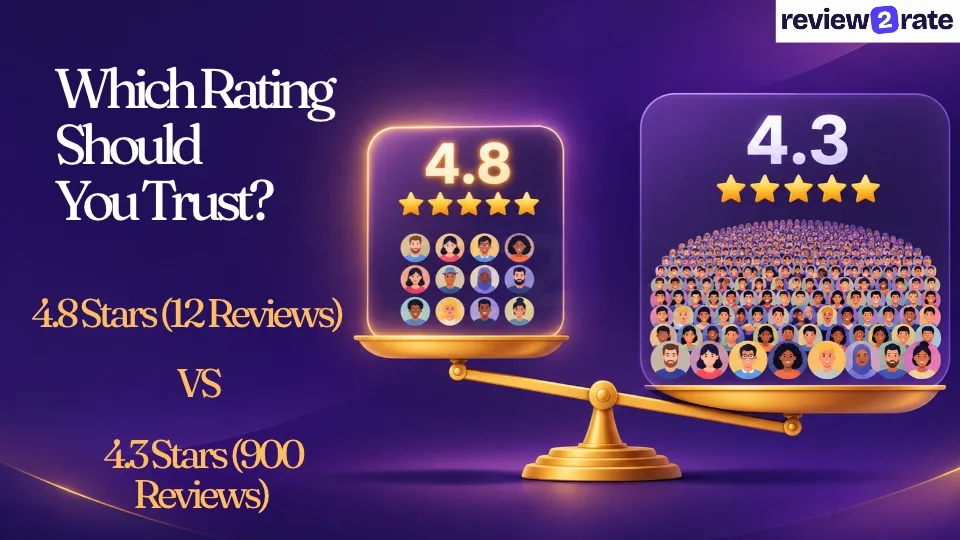
Listing A shows a glowing 4.8 stars from 12 reviews.
Listing B shows a more modest 4.3 stars from 900 reviews.
Your instinct says A is better. The number is higher, after all. But a small voice says that 12 people is not very many.
That small voice deserves to be heard. In this guide, you will learn exactly how to compare ratings like these, why the number of reviews matters as much as the stars, and how to make a confident decision in under a minute.
The short answer: In most cases, the 4.3 from 900 reviews is the safer and more trustworthy signal. The 4.8 from 12 reviews might turn out to be the better product, but you cannot know that yet. Read on to see why, and to learn the one situation where the smaller number can win.
A Star Rating Has Two Parts: The Score and the Confidence
Most people look only at the score. But every rating really answers two separate questions:
- How good do people say it is? (the average star rating)
- How sure can we be about that? (the number and quality of reviews behind it)
A 4.8 tells you the first part. It tells you almost nothing about the second. With only 12 reviews, the score is more of a first impression than a verdict.
Think of it like a cricket batter. A player who scores 80 in one match and a player who averages 45 across 100 matches are not directly comparable. The first might be brilliant, but the second has proved it, again and again.
Why 12 Reviews Can Swing Wildly
Here is a simple example you can check with a calculator.
Imagine Listing A has 12 reviews: ten five-star ratings and two four-star ratings. That works out to an average of about 4.83, which the listing shows as 4.8.
Now three unhappy customers leave one-star reviews. The listing now has 15 reviews, and the average falls to roughly 4.07.
Three bad experiences moved the score by more than 0.7 stars.
Now try the same thing with Listing B. It has 900 reviews averaging 4.3. Add the same three one-star reviews and the average moves from 4.30 to about 4.29. You would barely notice.
| Listing | Before 3 bad reviews | After 3 bad reviews | Change |
|---|---|---|---|
| A: 12 reviews | 4.83 | 4.07 | Drops about 0.76 |
| B: 900 reviews | 4.30 | 4.29 | Drops about 0.01 |
This is why a high score from a small group is fragile. It can look wonderful today and very different next month, simply because a few more people shared their experience.
The "Likely Range" Trick: What the Score Really Means
Here is a simple way to think about it. Instead of reading a rating as one exact number, read it as a range. The fewer the reviews, the wider the range.
Using a rough statistical rule of thumb (and assuming a typical spread of opinions of about one star), the picture looks like this:
| Listing | Shown rating | Reviews | Roughly where the true quality may sit |
|---|---|---|---|
| A | 4.8 | 12 | About 4.2 to 5.0 |
| B | 4.3 | 900 | About 4.2 to 4.4 |
Look at what this reveals. Listing A could be a superstar, or it could be no better than Listing B. Listing B is a known quantity: you can be fairly sure that it is a solid, good product.
Note: This is a simplified illustration to build intuition, not an exact formula. Real review spreads vary, and ratings are never perfectly random.
So the real choice is not "4.8 vs 4.3". It is "possibly excellent but unproven" vs "reliably good and well tested". Which one you prefer depends on how costly a bad purchase would be for you.
Try It Yourself: Which Listing Would You Trust?
Test your instincts with these four quick scenarios. Make your choice first, then click to reveal the answer.
Scenario 1: 4.9 stars from 8 reviews, all posted within three days, versus 4.4 stars from 600 reviews spread over two years.
Answer: the 4.4. Eight reviews is a very small sample, and having all of them arrive in a three-day window is a reason for caution. It could be an early-access group, a launch campaign or simply a coincidence. The 600 reviews spread over two years show how the product behaves over time. See our guide on spotting fake reviews for more on suspicious timing.
Scenario 2: 4.6 stars from 3,000 reviews, mostly short lines like "nice product", versus 4.4 stars from 400 reviews that describe real daily use.
Answer: lean towards the 400 detailed reviews. Volume is helpful, but information is what lets you decide. Four hundred reviews that mention battery life, build quality and after-sales support help you judge whether the product fits your needs. Three thousand one-liners tell you people were generally satisfied, but not why.
Scenario 3: 4.2 stars from 150 reviews where most complaints mention the same battery fault, versus 4.0 stars from 150 reviews where complaints are scattered and unrelated.
Answer: it depends on the complaint. A repeated, specific problem is a pattern, and a pattern is more important than a one-off. If battery life matters to you, the lower-rated product with random complaints may actually be the safer pick. Always read what the low ratings say, not just how many there are.
Scenario 4: A newly launched phone with 4.7 stars from 20 reviews, versus its older model with 4.4 stars from 2,000 reviews.
Answer: treat the new phone's score as an early signal, not a verdict. Twenty reviews cannot tell you how the phone behaves after six months of use. If you are happy to take a little risk, go for the new model, but check the return policy and look for reviews from people who have owned it for a few weeks or more. If you want certainty, the older model has proved itself.
5 Things That Matter More Than the Star Number
Once you know that the score alone is not enough, here is what to look at instead.
1. How Many Reviews Are Behind the Score?
More reviews generally means more reliable. There is no magic number, but as a rough guide, treat anything under 20 reviews as an early signal, and treat a few hundred as a much firmer picture. For niche items and local services, fewer reviews is normal, so adjust your expectations (more on that below).
2. How Recent Are the Reviews?
Products change. A phone may receive a software update that improves the camera or, sometimes, causes problems. A restaurant may change its chef. A service provider may change its team. Reviews from the last few months tell you what you are likely to get today, while reviews from three years ago tell you what happened then.
3. How Are the Ratings Spread Out?
Two products can both show 4.3 stars and be completely different.
- Product X: Most reviews are four and five stars, with a few threes. Experiences are consistent.
- Product Y: Many five-star reviews and many one-star reviews. Experiences are wildly different, and the average hides it.
If a platform shows a breakdown of how many reviews gave each star level, use it. A polarised spread suggests that something is inconsistent, such as quality control, delivery or service.
4. Do Reviewers Say Anything Specific?
"Great product!" is pleasant, but it is not useful. Look for reviewers who tell you how long they have used it, what they use it for, and what they like or dislike. Specific details make a review more helpful, and they also make fabricated reviews easier to spot.
5. Do the Same Complaints Keep Appearing?
One person complaining about late delivery might be unlucky. Ten people reporting the same fault is a pattern. Scan the three-star and two-star reviews, because they are often the most balanced and informative.
Your 60-Second Trust Score
Use this quick checklist on any listing. Give each question 2 points for yes, 1 point for partly, and 0 points for no.
| Question | Score |
|---|---|
| 1. Are there at least a few dozen reviews (or an unusually large number for a niche or local item)? | 0 / 1 / 2 |
| 2. Are several reviews from the last few months? | 0 / 1 / 2 |
| 3. Do most reviewers describe real, specific experiences? | 0 / 1 / 2 |
| 4. Are the complaints scattered rather than repeating the same serious problem? | 0 / 1 / 2 |
| 5. Do independent sources broadly agree with the rating? | 0 / 1 / 2 |
Your result:
- 8 to 10 points: Strong trust signals. The rating is a reasonable guide.
- 5 to 7 points: Mixed. Read more reviews, check the return policy and compare with another listing.
- 0 to 4 points: Weak evidence. Treat the score as a rough hint and look for more information before spending serious money.
Notice that a 4.3 from 900 detailed, recent reviews might score 9 or 10, while a 4.8 from 12 vague reviews might score 3. That is the whole point of looking beyond the stars.
When the 4.8 With 12 Reviews Can Actually Win
It would be unfair to say that small review counts are always bad. There are real situations where the 4.8 deserves your attention:
- Local and specialist services. A neighbourhood tutor, a local pest-control company or a small repair shop may simply not have many customers online. Twelve detailed, believable reviews can be very informative.
- Niche products. A specialised item bought by few people will never have 900 reviews.
- Very new listings. A good product has to start somewhere. Early reviews are valuable if they are detailed and credible.
- Long-term owners. Twelve reviews from people who have used the product for a year can be worth more than 200 reviews written a day after delivery.
In these cases, read the reviews themselves rather than just the number. If all twelve are specific, balanced and believable, the 4.8 may well be the better choice.
A Real Look at Small Review Counts on Review2Rate
We would rather be honest about this than pretend that every listing is perfect, so here is a real example from our own platform at the time of writing.
- The BMW X5 (2024) currently shows a 5.0 rating from 4 reviews.
- The Herman Miller Aeron Chair currently shows a 4.0 rating from 5 reviews.
Both are genuine reviews from real people, and both are useful. But with so few reviews, neither score should be read as a final verdict. They are the start of a conversation, and each new review makes the picture clearer. That is exactly why we ask our community to add specific, honest detail: the more people who weigh in, the more you can trust the score.
Figures change as new reviews arrive.
How to Read a 4.3 From 900 Reviews Like a Pro
A big review count is reassuring, but it is not a free pass. Here is how to get the most out of a high-volume listing:
- Sort by most recent. Check that recent reviews match the overall rating.
- Read the three-star reviews. They usually explain trade-offs honestly.
- Look for the same complaint in several reviews. That is your real warning sign.
- Check the one-star reviews for patterns. Are they about the product itself, or about delivery and packaging that you may not care about?
- Be aware of mixed variants. Some listings combine reviews of different models, colours or sellers.
Remember also that large numbers can be inflated. Our guide to 10 warning signs of fake reviews explains how to spot manipulated ratings, whatever the review count.
The Decision Cheat Sheet
| If you see this | It usually means | What to do |
|---|---|---|
| High score, very few reviews | Promising but unproven | Read every review. Check the return policy. |
| Good score, hundreds of reviews | Reliably good | Check recent reviews and repeated complaints. |
| Very high score, thousands of short reviews | Popular, but little detail | Look for detailed reviews and independent sources. |
| Average score, polarised ratings | Inconsistent experience | Find out what separates the 5-star and 1-star reviews. |
| Sudden jump in new five-star reviews | Possible campaign or launch effect | Compare dates and check for repeated wording. |
Are You Making These Common Mistakes?
- Comparing averages without comparing review counts. A 4.8 and a 4.3 are not comparable unless you know the sample size.
- Ignoring the lower-star reviews. This is often where the useful truth is found.
- Assuming a perfect 5.0 is the best. A perfect score from a small group is often the least tested.
- Trusting a rating more than a return policy. For expensive purchases, a good return window protects you better than any star rating.
- Reading only the first page of reviews. The first page may show only the most popular reviews, not the most recent.
Why Your Review Makes Everyone's Ratings More Trustworthy
Here is something worth thinking about. Every rating that feels unreliable is unreliable for one reason: not enough people have shared their experience yet.
When you write a review, you are not just leaving an opinion. You are helping to turn a shaky 12-review score into a dependable 120-review score, and that benefits every future buyer.
The most helpful reviews have a few simple things in common:
- They say how long you have used the product or service.
- They mention what you liked and what disappointed you.
- They are specific, for example by talking about battery life, comfort, delivery, support or value for money.
- They include photos when relevant.
On Review2Rate, every review, photo and helpful vote earns you points, and the top reviewer each month wins a ₹5,000 Amazon voucher. So you can help other buyers and be rewarded for doing it.
Bought something recently? Used a service you would recommend (or warn people about)?
Write your review in two minutes and help the next buyer decide with confidence.
Own a Business With Only a Handful of Reviews?
If you run a business and your listing has just a few reviews, do not panic. A small number of detailed, honest reviews is far more valuable than a pile of vague praise. Here is what helps:
- Ask satisfied customers to share specific details about their experience, not just a star rating.
- Respond politely and helpfully to every review, including critical ones.
- Never pay for, script or pressure customers into giving a particular rating. It damages trust and can backfire.
- Keep your listing details accurate so that reviewers know exactly what they are rating.
You can claim your Review2Rate listing for free, reply to reviews and show your score on your own website. Claim your free business listing.
Browse Reviews by People Like You
Ready to put your new skills to use? Explore real experiences from real buyers in India:
You might also enjoy our guide on whether AI smartphones are actually worth buying in 2026.
Frequently Asked Questions
Is a 4.8 rating always better than a 4.3 rating?
No. A rating is only as reliable as the number and quality of reviews behind it. A 4.8 from 12 reviews is a promising early signal, while a 4.3 from 900 reviews is a much better-tested result.
How many reviews do I need before I can trust a rating?
There is no single magic number. As a rough guide, under 20 reviews is an early signal, a few dozen is a reasonable start, and several hundred gives a firmer picture. Quality, recency and detail matter as much as quantity.
Does a perfect 5.0 rating mean the product is perfect?
Not necessarily. A perfect score usually comes from a small number of reviews. It may be genuine, but it is often the least tested rating of all. Read the individual reviews to see whether they are detailed and credible.
Why do reviews with fewer stars sometimes help more?
Three-star and four-star reviews often describe both strengths and weaknesses, so they show you the trade-offs. That is useful when you are deciding whether a product suits your particular needs.
Should I ignore products with very few reviews?
No. New products, niche items and local services naturally have fewer reviews. Read them carefully, check the return policy and look for detailed, specific experiences. Just avoid treating the average score as a firm verdict.
Can a high review count be fake?
Yes. Large numbers can be inflated by coordinated campaigns or low-quality reviews. Check for repetitive wording, sudden spikes, vague praise and whether independent sources agree with the rating.
What is more important: the average rating or the number of reviews?
Both matter, and neither works well alone. The average tells you how good people say it is, and the number of reviews tells you how confident you can be. Together with recent and detailed feedback, they give you a trustworthy picture.
How do I know if reviews are recent enough?
Look for reviews from the last few months, particularly for products that receive software updates or services that change over time. If all the reviews are old, the rating may not reflect what you will receive today.
What is a rating distribution, and why does it matter?
A rating distribution shows how many reviews gave each star level. Two products can share the same average but have very different spreads. A polarised mix of five-star and one-star reviews suggests inconsistent experiences, even when the average looks fine.
How can I help make ratings more trustworthy?
Share your own honest experience. Describe what you bought, how long you used it, what you liked, what disappointed you and add photos if possible. Every detailed review helps the next buyer.
Final Verdict: Trust the Evidence, Not Just the Number
So, which should you trust: 4.8 stars from 12 reviews or 4.3 stars from 900?
In most cases, trust the 4.3 from 900. It has been tested by many more people, so it is far less likely to surprise you. The 4.8 from 12 may be wonderful, but it has not yet proved it.
The smartest buyers do not stop at the stars. They check how many reviews there are, how recent they are, how specific they are and whether the complaints repeat. A minute of reading can save you thousands of rupees and a lot of frustration.
And when you find something that works (or does not), pay it forward. Write a review, add the detail you would have wanted to read, and help turn every uncertain score into one that people can trust.
Review2Rate: Real Reviews. Real Experiences. For the People, By the People.
Editorial note: The calculations in this article are simplified illustrations designed to build intuition, and are not exact statistical formulas for any specific listing. Listing figures from Review2Rate were accurate at the time of writing and will change as new reviews are added. This guide is for general consumer awareness and does not constitute professional advice.
Used something we wrote about?
Add your own score. Every review earns points toward this month's prize.
Write a review